
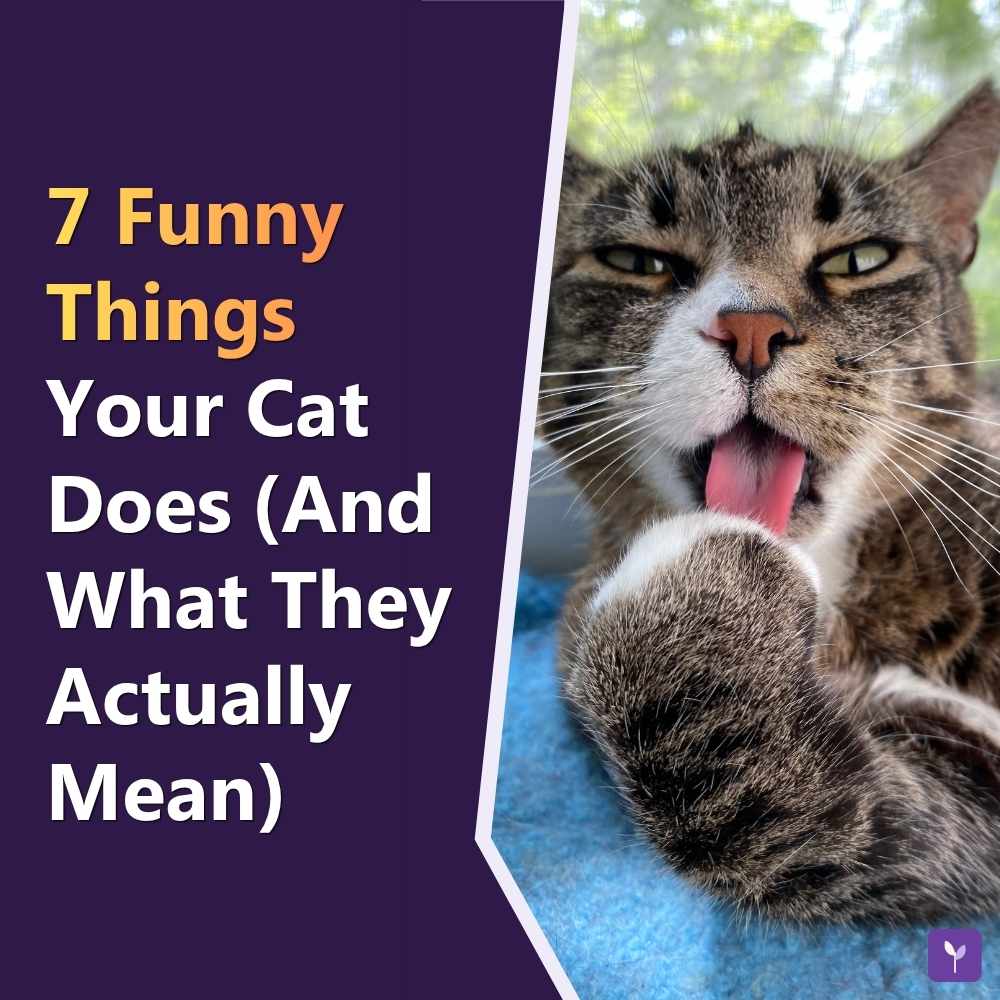
Cats are strange little roommates.
One minute your cat sits on the windowsill like a tiny statue. The next it sprints across the room for no reason, knocks a pen off the table while staring you dead in the eye, then falls asleep in a shoebox.
If you have ever looked at your cat and thought “what are you doing,” you are in good company.
The good news? Most of these odd habits make perfect sense once you know what is behind them.
Here is what you will discover:
- Why your cat shoves things off tables on purpose
- The slow blink that means more than you think
- What all that paw kneading is really about
- Why your cat brings you “presents” you did not ask for
- The reason for those late-night zoomies
Let me walk you through seven of the most common ones.
1. Knocking Things Off the Table
You set a glass near the edge. Your cat strolls up, makes eye contact, and taps it off with one paw.
Classic.
This is not your cat being a jerk, even though it feels that way.
Cats explore the world with their paws. Batting at something tells them whether it moves, rolls, makes noise, or reacts. A pen that clatters to the floor is, to a cat, a tiny science experiment.
There is often a second reason: you.
The moment that glass hits the floor, you jump up and pay attention. For a bored cat, that reaction is a reward.
The fix is simple. Keep breakables away from the edge. Give your cat something better to bat around, like a small ball or a toy mouse.
2. The Slow Blink
Watch your cat across the room. If it looks at you and slowly closes and opens its eyes, you just got a compliment.
Animal behaviorists call the slow blink a “cat kiss.”
In the cat world, closing your eyes near another creature means you feel safe. A cat that slow-blinks at you is saying it trusts you.
Here is the fun part. You can answer back.
Look at your cat, relax your face, and give a slow blink of your own. Many cats will return it.
It is one of the easiest ways to tell your cat you are friendly, in a language it already knows.
3. Kneading With Their Paws
Your cat climbs into your lap and starts pressing its paws into you, over and over, like it is making bread.
Some people call it “making biscuits.”
This goes all the way back to kittenhood. Newborn kittens knead against their mother while nursing to help the milk flow.
The habit sticks around into adulthood. When a grown cat kneads, it usually means it feels safe, relaxed, and content.
So if your cat kneads on you, take it as a compliment. Claws and all.
You have officially been marked as cozy and safe.
4. Bringing You “Gifts”
You wake up to find a toy in your shoe. Or, if your cat goes outside, something less pleasant.
Either way, your cat brought you a present.
This comes from the natural hunting instinct. In the wild, cats catch prey and carry it back to a safe spot.
Some experts believe house cats share their catch with the humans they bond with, almost like family.
It is not the gift any of us would pick. But the intention is sweet. Your cat is treating you like one of its own.
A cat that brings you its “catch,” even a fuzzy toy mouse, is paying you one of the highest compliments in its world.
If your cat is an indoor hunter, give it plenty of toys to stalk and pounce on. It feeds the instinct without any surprises in your slippers.
5. The Zoomies
It is 11 p.m. The house is quiet.
Suddenly your cat tears around the room at top speed, bounces off the couch, and skids around a corner before stopping like nothing happened.
Cat people call these bursts the zoomies.
Cats build up energy through the day, especially indoor cats who nap a lot. Every so often they need to burn it off all at once.
It is usually nothing to worry about.
If the zoomies hit at night and keep waking you up, a good play session before bed can help. Tire your cat out on purpose, and it has less fuel for the 2 a.m. grand prix.
6. Hiding in Boxes
You buy your cat an expensive bed. Your cat ignores it and climbs into the cardboard box the bed came in.
Every time.
There is a real reason for this. Boxes make cats feel safe.
A small space with walls on most sides lets a cat watch the room while staying hidden. That taps into both their hunting side and their need for security.
Studies on shelter cats have found that giving them a box to hide in helps them settle and feel calmer in a new place.
So the box is not a snub. It is your cat doing what cats do.
Lean into it. A few boxes or a covered hideaway around the house can make a nervous cat feel more at home.
7. Chattering at Birds
Your cat sits at the window, spots a bird outside, and makes a strange, rapid chattering sound with its mouth.
This one is pure hunting instinct switching on.
The sight of prey just out of reach gets a cat excited and a little frustrated. Some researchers think the jaw movement copies the bite cats use on prey. Others think it is just the sound of a very interested, worked-up cat.
Either way, it means your cat’s inner hunter is wide awake.
A window perch and a bird feeder outside can give your indoor cat hours of free entertainment. And they clearly love it.
Why It Pays to Understand Your Cat
Once you know what these behaviors mean, your cat stops being a mystery and starts being a lot more fun.
You can slow-blink back. You can give the zoomies somewhere to go. You can stop being annoyed about the box and just hand over more boxes.
A cat that gets to act like a cat is a happier, easier roommate. One with things to stalk, bat, climb into, and watch.
Most “bad” cat behavior is really just a normal instinct with nowhere good to go.
Want to give your cat better outlets for all these instincts? Our cat toys and enrichment picks are built for exactly that, from things to pounce on to cozy spots to hide.
Give those natural habits a healthy home, and you will both enjoy the company a lot more.